
One mind.
Many bodies.
SYNAPSE is autonomy software that makes a fleet of machines act as one. One shared picture, one coordinated response, at machine speed, with or without a link to the ground.
Every machine is an island.
Autonomy today makes a single vehicle smart. The fleet is still wired to the ground: every sensor feed flows down, every decision flows back up. The more machines you field, the more operators and bandwidth you burn. And the link itself is the first thing an adversary breaks.
Round-trip decisions
The ground loop decides in minutes. Contested engagements are over in seconds.
A single point to sever
One relay, one antenna, one operations floor. The adversary only has to break one thing.
Blind when it matters
Cut the link and each machine is alone: no shared picture, no coordinated response.
The decision moves to the edge.
SYNAPSE replaces the ground loop with a peer mesh. Every vehicle shares what it sees, and every vehicle independently arrives at the same picture, the same assessment, the same tasking. No leader to kill. No center to jam. A human sets the intent; the fleet works out the how, and every action is authenticated, logged, and replayable.
Capability that exists only in the collective.
SYNAPSE is not about making each machine smarter. It is about capabilities that appear when machines share a mind and vanish the moment you take it away: perception no sensor has, judgment no single computer should be trusted with, action no operator could choreograph. Watch one below. No single sensor can declare this target. The fleet can.
Resolution that scales with the fleet
One node measures a bearing: an infinite ray. Two intersect it into a region. Ten collapse it to a fix no single aperture could resolve, held identically by every node.
Detection below any one sensor's threshold
A target too faint for any node to call. Weak returns that agree across independent geometries stack into a confident track. Sensitivity without the false alarms.
Cross-cueing ahead of the event
One machine's glimpse re-points the whole fleet's sensors toward where the target will be, before it arrives in their view.
Judgment that survives a liar
Every node assesses independently; the fleet agrees on the verdict. A compromised machine is outvoted, not obeyed.
Geometry that organizes itself
Spread to locate. Converge to mass. Redistribute when a node is lost, with a searcher promoting itself to tracker. No formation was programmed.
Mass and maneuver at machine speed
Simultaneity no link can deliver. The fleet agrees on the move locally and executes it together, tighter than any operator could choreograph.
The capability lives in the coordination, not in any asset. Every node added makes the fleet see sharper, judge better, and act faster. And it ships as software, on hardware you already fly.
And resilience? No center to jam, no leader to kill, graceful degradation under loss. Real, valuable, and a corollary. Mentioned once, last, on purpose.
Validate once. Deploy across every fleet.
The core is domain-blind. Vehicle, sensor, and mission specifics are modular; the coordination underneath never changes. The same validated software runs in contested airspace, in orbit, and on open water.
Aircraft teams
Aircraft that hold one air picture and act on it together, through jamming and GPS denial.
Constellations
Missile-track custody that never hands off. Constellations that keep coordinating through ground-link denial.
Robotic fleets
Fleets that build one map and respond as one system.
Uncrewed vessels
Vessels holding a common surface picture across contested water.
SYNAPSE
The coordination layer.A drop-in software subsystem that rides alongside existing flight software and makes the fleet act as one. No rip-and-replace. No vendor lock-in.
SIMULACRUM
The proving ground.A full-fidelity digital twin where every simulated vehicle runs the real autonomy stack. Rehearse the worst day of the mission before hardware ever ships.
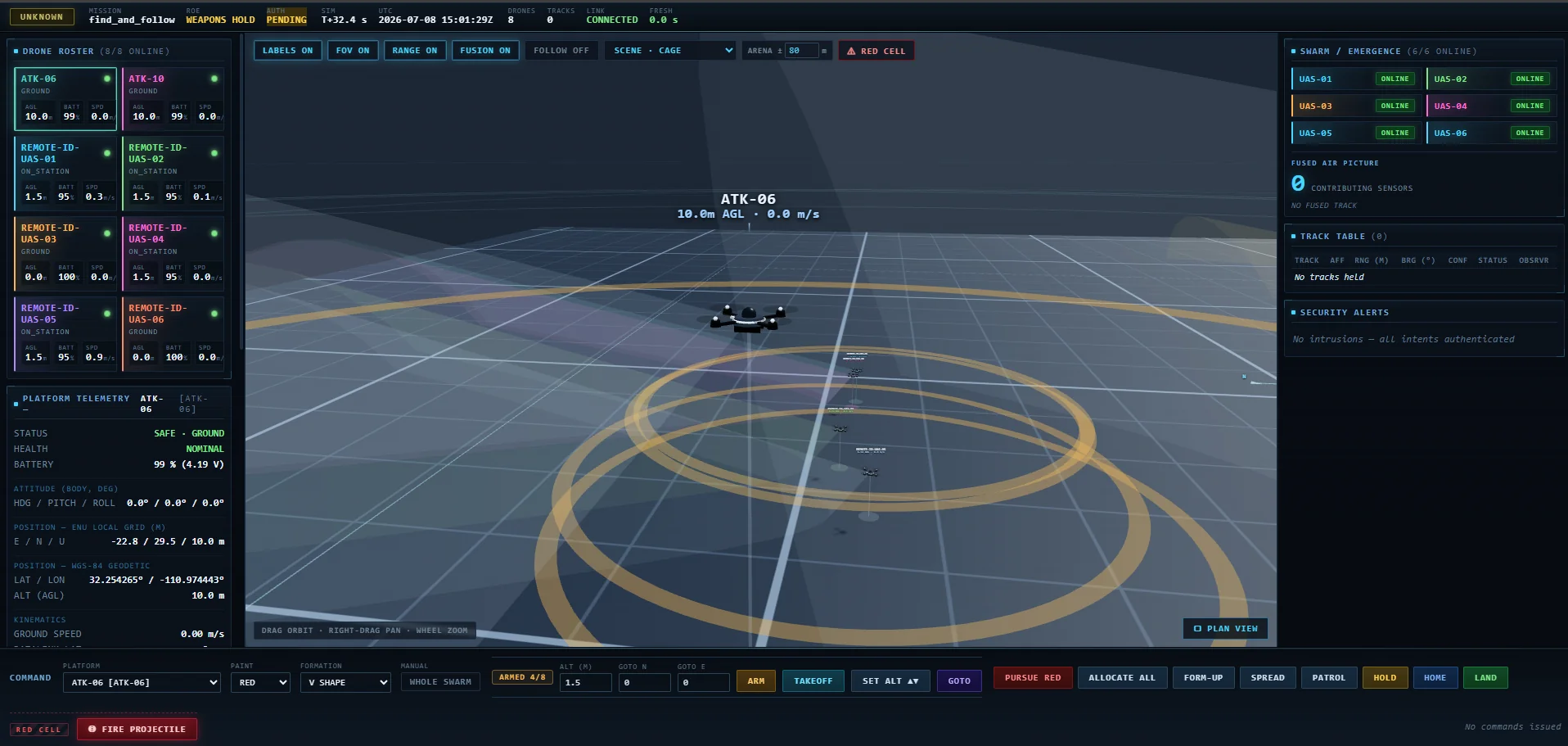
The fleets are coming. The coordination layer isn't.
Fleets are the new unit of force
Every domain is moving from a few exquisite platforms to many attritable ones. The mandate for mass is public, funded, and accelerating.
Engagements outrun the ground
Contested fights are decided faster than a round trip to any operations center. The loop has to close where the machines are, or it closes too late.
The platforms exist. The mind doesn't.
Vehicles are mass-produced and autonomy flies one aircraft at a time. What is missing is the software that makes a thousand machines one instrument. That is the layer we build.
We built the machines. Now the mind that flies them.
Sentinel's founding team spent decades building flight hardware where a coordination failure ends the mission: launch vehicle engines, spacecraft mechanisms, the James Webb Space Telescope, autonomous flight test. Now we build the software that lets fleets fly themselves.
See a fleet act as one.
SIMULACRUM demonstrations are available now. Watch a fleet hold custody through denial, live.