
The coordination layer.
SYNAPSE is a drop-in software subsystem that makes existing fleets act as one. It rides alongside the flight software already on the vehicle, joins its peers over an encrypted mesh, and turns independent machines into a single coordinated system.
Four steps. No center.
Every vehicle shares what it senses
Observations are authenticated and shared peer to peer over an encrypted mesh. Raw evidence moves; no vehicle waits for orders.
Every vehicle builds the same picture
Each vehicle independently assembles the identical operational picture from the shared evidence. There is no master copy to corrupt and no fusion center to destroy.
The fleet settles on one plan
Assessment and tasking are agreed on board, tolerant of lost, jammed, and compromised members. Bad inputs are outweighed by the fleet.
Each vehicle executes its share
The fleet acts as one and adapts as the situation changes. A human sets the intent and the boundaries; the fleet works out the how.
Capabilities no single machine can have.
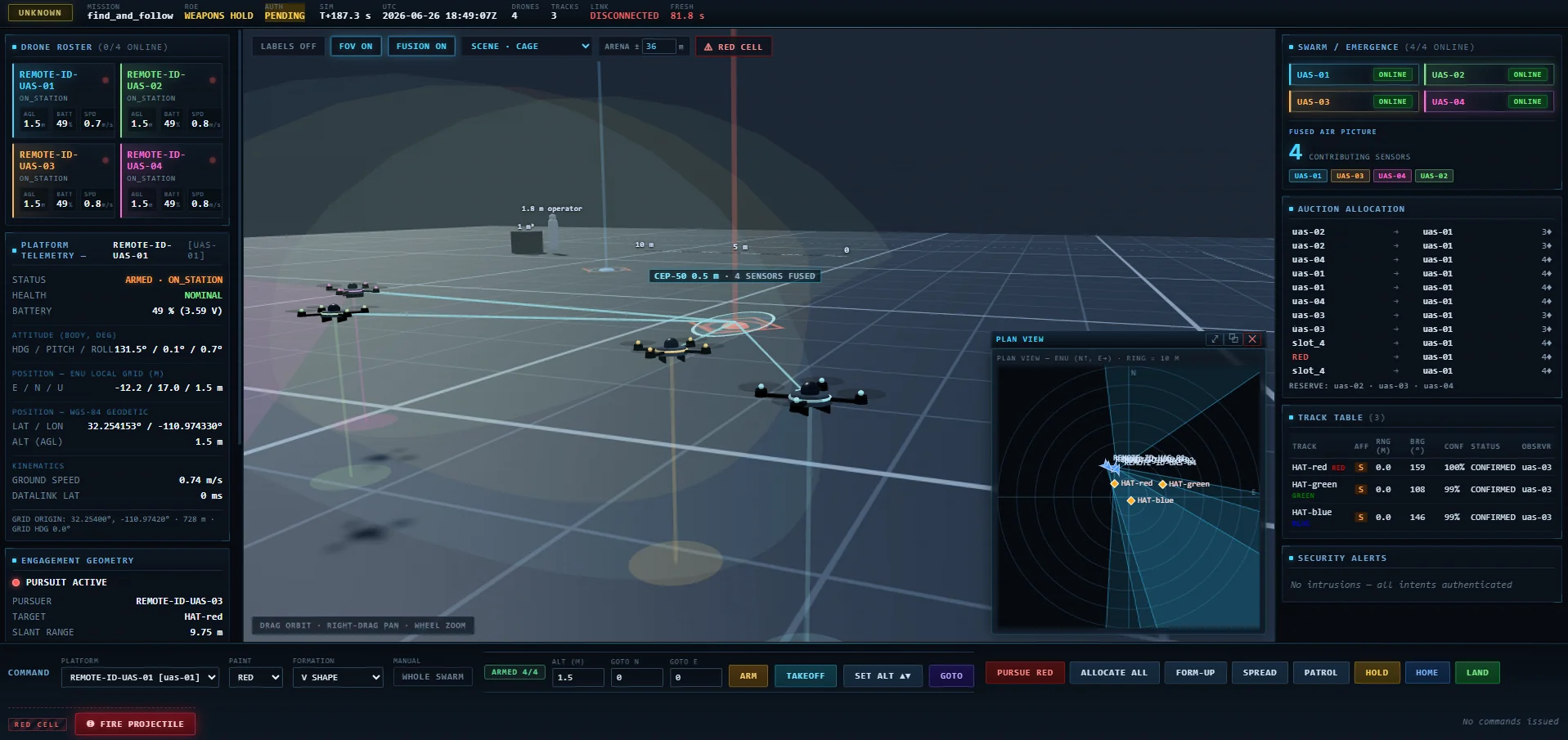
The four steps produce more than resilience. They produce capability that exists only in the coordinated collective, in three families that build on one another, and the families keep growing as missions do. Take any one machine out of the fleet and these do not shrink. They vanish. What follows is a sample, not a ceiling.
Resolution that scales with the fleet
One node measures a bearing: an infinite ray. Two intersect it into a region. Ten collapse it to a fix no single aperture could resolve, held identically by every node.
Detection below any one sensor's threshold
A target too faint for any node to call. Weak returns that agree across independent geometries stack into a confident track. Sensitivity without the false alarms.
Custody without handoff
Every node holds the whole track at once. A target crossing fields of view produces no handoff, so there is no handoff to drop.
Deception exposed by geometry
A decoy can be convincing from one vantage point. It cannot stay consistent across ten at once. The contradiction is the detection.
Cross-cueing ahead of the event
One machine's glimpse re-points the whole fleet's sensors toward where the target will be, before it arrives in their view.
Judgment that survives a liar
Every node assesses independently; the fleet agrees on the verdict. A compromised machine is outvoted, not obeyed.
Reasoning a step ahead
The fleet spreads its attention across everywhere the target could go next. Whichever branch it takes, something is already looking.
Priorities without a planner
Scarce sensors and effectors are assigned by the fleet itself, continuously, at machine speed, with no central optimizer to kill.
Geometry that organizes itself
Spread to locate. Converge to mass. Redistribute when a node is lost, with a searcher promoting itself to tracker. No formation was programmed.
Mass and maneuver at machine speed
Simultaneity no link can deliver. The fleet agrees on the move locally and executes it together, tighter than any operator could choreograph.
The loop closes at the edge
Detect, decide, act inside the collective, within boundaries a human set, every step recorded and replayable, even through a blackout.
Rides beside what you already fly.
No rip-and-replace
SYNAPSE deploys alongside existing flight software as a standalone subsystem. Your vehicles keep their autopilots, their interfaces, and their certifications.
Any maker, one mesh
The fleet does not need to share a manufacturer to share a mind. SYNAPSE coordinates across vehicles from different vendors without locking you into any of them.
One core, many missions
Vehicle, sensor, and mission specifics are modular integrations on an unchanging core. Validate the core once; configure it for the mission at hand.
Autonomy you can audit.
Trust in autonomy is earned with evidence. SYNAPSE is built so that every action it takes can be authorized in advance, attributed in the moment, and reconstructed after the fact.
A human always in command
Operators set mission intent, rules, and boundaries. Autonomy operates strictly inside them, at the autonomy level the mission calls for.
Authenticated everything
Observations and orders are cryptographically authenticated. Spoofed inputs and unauthorized commands are rejected by the fleet itself.
A complete record
Every decision is logged with its full context and can be replayed exactly: for test, for accreditation, and for after-action review.
Start with one. Grow to the fleet.
A pair of vehicles
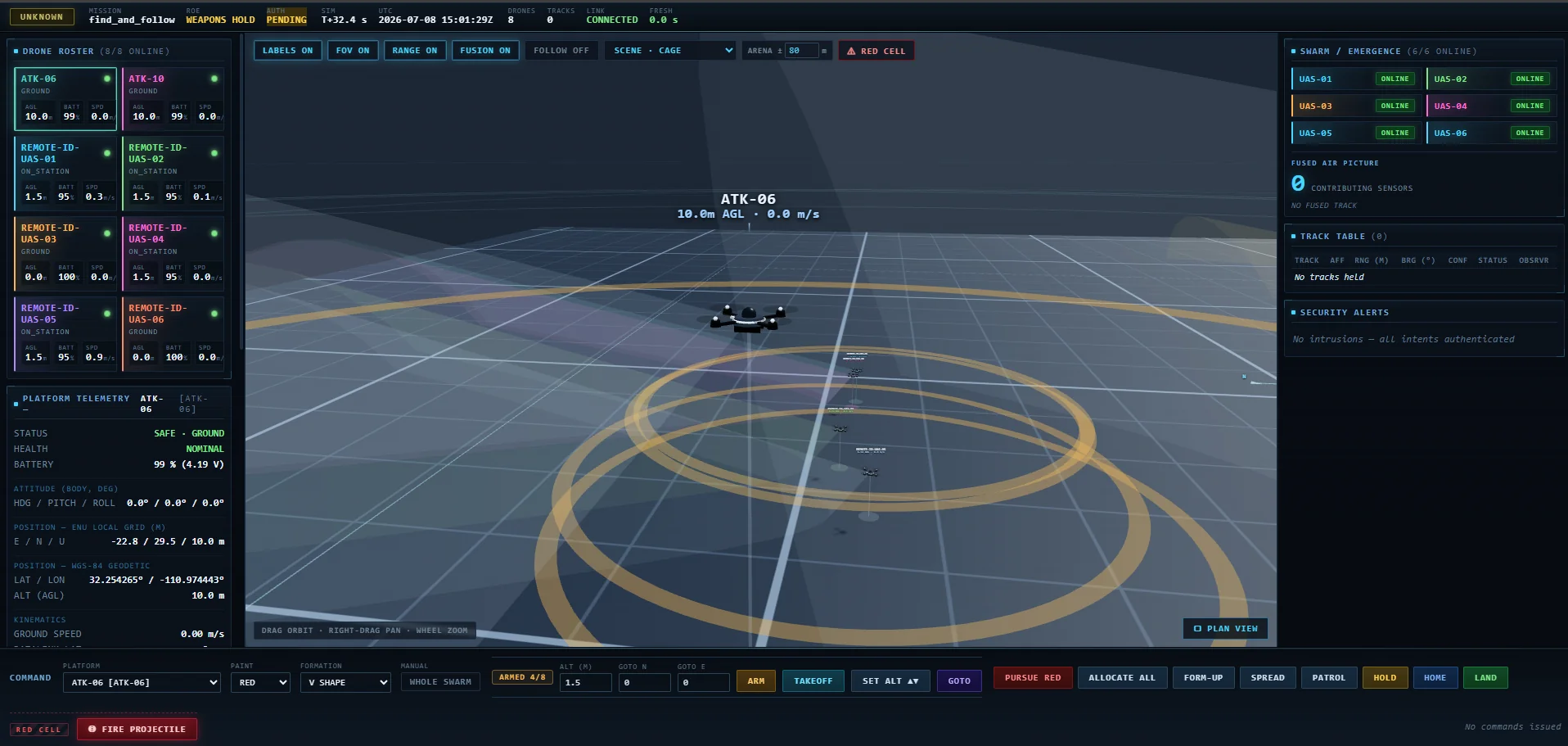
Coordination starts at two. Fly the stack beside your existing flight software on a pair and watch them build one picture that neither holds alone.
A team of four
Four members is where the fleet starts to forgive failure: a lost, jammed, or compromised vehicle is outvoted and the mission continues. Teaming pilots run here.
Full fleet
Fleet-scale coordination in which every added vehicle makes the whole system sharper, not harder to operate.
See it hold the picture through denial.
A live SIMULACRUM demonstration is the fastest way to understand SYNAPSE.